
ABSTRACT
This report analyses conflict-related sexual violence (CRSV) documented in the 2025 UN Secretary-General’s Report (S/2025/389), which recorded a 25% global increase compared to 2023, with more than 4,600 verified survivors across 21 countries. To ensure analytical coherence, the study focuses on five case studies drawn from two regions: Sub-Saharan Africa (Central African Republic, Democratic Republic of the Congo, Somalia, and South Sudan) and the Caribbean (Haiti). These contexts were selected because they represent the highest concentration of verified CRSV cases in 2024–2025 and illustrate both traditional armed-conflict settings and non-traditional conflict environments characterised by organised armed violence. The study examines how patterns of CRSV constitute violations of States’ obligations under the Convention on the Elimination of All Forms of Discrimination against Women (CEDAW). Using a mixed-method approach combining legal-normative analysis, qualitative thematic coding, and quantitative data mapping, the report identifies systemic failures to prevent, investigate, prosecute, and remedy CRSV. It further assesses structural, political, and institutional barriers that impede compliance, including weak governance, insecurity, underfunded services, and discriminatory legal frameworks. The study concludes with targeted recommendations to strengthen accountability by integrating CEDAW more effectively into domestic legal systems, UN peace and security mandates, and international accountability mechanisms.
EXECUTIVE SUMMARY
Conflict-related sexual violence (CRSV) increased sharply in 2024, with the UN documenting a 25% rise compared with the previous year and over 4,600 survivors in 21 countries. CRSV remains a strategic weapon of war, repression, and social control, disproportionately affecting women and girls but also impacting men, boys, LGBTQI persons, rural women, displaced populations, and ethnic minorities. The consequences include severe physical and psychological harm, entrenched social stigma, and long-term marginalisation, including for children born of wartime rape.
This report evaluates the five most affected contexts – CAR, DRC, Somalia, South Sudan, and Haiti – and finds clear and widespread violations of CEDAW Articles 2, 3, 5, 6, 12, 14, and 16. Across all settings, state authorities either perpetrate CRSV directly or fail to exercise due diligence to prevent and respond to abuses by non-state actors. Data from UN and humanitarian sources reveal severe patterns: CAR documented at least 413 UN-verified CRSV survivors; DRC registered tens of thousands of medical CRSV cases in 2023–2024; Somalia verified 267 cases of child sexual violence; South Sudan recorded 246 CRSV survivors in 2024; and Haiti reported over 3,598 gender-based violence (GBV) incidents linked to gangs, with hundreds of verified CRSV survivors. Structural barriers – including weak justice systems, lack of forensic and medical capacity, insecurity, underfunded survivor services, stalled legal reforms, and contested territorial control – undermine accountability efforts. In all contexts, monitoring gaps and lack of disaggregated data impede a full assessment of CRSV prevalence.
While the UN Secretary-General’s report recommends strengthening existing national frameworks, expanding survivor-centred services, and enhancing justice mechanisms, this report identifies additional measures necessary to close persistent accountability gaps. These include integrating CEDAW compliance indicators into national action plans, establishing independent oversight for security forces, applying command responsibility, vetting perpetrators from state institutions, creating national CRSV data systems, linking domestic and international investigations, using conditionality and sanctions, strengthening survivor protection frameworks, embedding CRSV accountability into peace negotiations, and establishing State-funded reparations schemes. As the conclusion stresses systemic, global patterns of State and non-State non-compliance, together, these strategies aim to reinforce CEDAW as a central legal tool for preventing, addressing, and remedying CRSV in conflict settings.
1. INTRODUCTION AND BACKGROUND
On 14 August 2025, the United Nations (UN) published its 16th Report on Conflict-Related Sexual Violence (S/2025/389). The report reveals a 25% increase in documented cases of conflict-related sexual violence (CRSV) compared to 2023, committed by state and non-state actors in 2024, with over 4,600 survivors across 21 countries for which information verified by the UN is available.
This situation marks one of the most severe upticks in such crimes and highlights the persistence of sexual violence as an intentional and systematic tactic of war, torture, terrorism, and political repression in 2024. While the report argues that CRSV continues to affect primarily women and girls, amounting to 92% of survivors), men and boys, LGBTQI people, ethnic minorities, and disabled people are increasingly represented as survivors of such abuse, ranging in age from one to 75 years old. The report also reflects on survivors’ the intersectional discrimination – including rural women, ethnic minority women, and refugee and migrant women, etc. – who face compounded stigma and socio-economic exclusion. In addition, those women who had been in detention and presumed to be raped face such stigma that results in rejection by their families and communities as well as children born of wartime rape who face lifelong marginalisation.
While the UN report provides a global overview, this study adopts a focused, case-study-based approach to enable in-depth legal and accountability analysis. Accordingly, this report concentrates on five contexts drawn from two regions: Sub-Saharan Africa (Central African Republic, Democratic Republic of the Congo, Somalia, and South Sudan) and the Caribbean (Haiti). Other countries referenced in the UN report – such as Bosnia and Herzegovina, Kosovo, Iraq, Libya, Ukraine, and Israel/Gaza – are acknowledged as part of the broader global pattern but fall outside the analytical scope of this report.
The five countries analysed in this report were selected based on two main criteria. Firstly, they represent the most severely affected contexts identified in the UN Secretary-General’s Report for 2024–2025 in terms of verified CRSV cases. Collectively, these five countries account for a substantial proportion of all UN-verified survivors globally. Secondly, the selected cases capture different manifestations of conflict-related sexual violence. CAR, DRC, Somalia, and South Sudan exemplify protracted armed conflicts involving state forces, non-state armed groups, and foreign actors. Haiti, while not a traditional armed-conflict setting, demonstrates how CRSV flourishes in situations of extreme armed violence, gang territorial control, and state collapse, thereby testing the application of CEDAW obligations beyond classical war contexts.
The five countries’ patterns represent clear breaches of CEDAW obligations, including:
Article 1 (gender-based violence as discrimination)
Articles 2 (state responsibility to eliminate discrimination)
Article 3 (state responsibility to guarantee women’s equal rights)
Article 5 (amendment of gender stereotypes)
Article 6 (state responsibility to suppress all forms of traffic in women and exploitation of prostitution)
Article 12 (women’s right to health and reproductive health)
Article 14 (protection of rural women’s rights)
Article 16 (equality in family life and freedom from forced pregnancy)
General Recommendation19 (gender-based violence amounts to discrimination)
General Recommendation 30 (state obligations in conflict-related contexts)
General Recommendation 35 (updated standards for gender-based violence).
Likewise, the consistent denial of humanitarian access and underfunding of survivor services further deepens systemic discrimination.
2. OBJECTIVES AND RESEARCH QUESTIONS
The aim of this report is to evaluate the extent to which States implicated in the 2025 UN report have violated their obligations under CEDAW in CAR, DRC, Somalia, South Sudan, and Haiti, identifies systemic gaps in prevention and response, assess the effectiveness of existing mechanisms for accountability and prevention, and explore ways to strengthen the treaty’s role in preventing and responding CRSV. Although the UN Security Council recognises CRSV as a threat to international peace and security, accountability mechanisms remain fragmented and often fail to address States’ human rights obligations. CEDAW provides a legally binding framework requiring States to prevent, investigate, punish, and remedy gender-based violence, yet its potential remains underutilised in conflict settings. This report examines how failures to address CRSV constitute violations of CEDAW and generates evidence-based recommendations to strengthen the Convention’s operational use within UN and national accountability systems.
3. RESEARCH QUESTIONS
How do the incidents of CRSV reported in 2024–2025 align with CEDAW-defined discrimination and State responsibility[1]?
What are the key structural, political, and institutional barriers to CEDAW implementation in conflict-related contexts?
How can CEDAW be better integrated into international human rights framework to strengthen global accountability[2] and compliance?
4. RESEARCH DESIGN AND METHODOLOGY
This study uses a multi-method analytical design combining legal-normative assessment, qualitative thematic coding, and quantitative pattern analysis. Primary data is drawn from the 2025 UN Secretary-General’s Report on Conflict-Related Sexual Violence, triangulated with humanitarian datasets (OHCHR, MSF, UNMISS, BINUH, GBVIMS) and relevant treaty-body materials (CEDAW Articles and General Recommendations 19, 30, 35).
The qualitative component employs a structured coding framework to classify CRSV patterns and map them to corresponding CEDAW obligations on prevention, protection, accountability, and non-discrimination. The legal-normative analysis assesses State responsibility, including obligations to regulate non-State actors. The quantitative component uses frequency counts and cross-country comparisons to visualise trends in CRSV prevalence and the degree of alignment between reported patterns and State compliance. A contextual analysis of political, institutional, and security factors further identifies structural barriers to CEDAW implementation.
5. INTERSECTING DYNAMICS OF SEXUAL VIOLENCE IN CONFLICT-AFFECTED STATES: A COMPARATIVE STUDY OF CAR, DRC, SOMALIA, SOUTH SUDAN AND HAITI
This section analyses the patterns and scale of CRSV in CAR, DRC, Somalia, South Sudan, and Haiti using data from the UN Secretary-General’s Report, complemented by information from civil society shadow reports, human rights organisations, and humanitarian actors. Across all five contexts, CRSV functions as a pervasive and strategic tool of war, repression, and social control, sustained by structural inequality, impunity, and weak governance. The assessment integrates documented incidents, state obligations, and available statistics to show how these patterns constitute violations of CEDAW, particularly under General Recommendations No. 19 (1992) and No. 35 (2017), which affirm that gender-based violence amounts to discrimination.
5.1. Patterns of CRSV Incidents
Across these five contexts, CRSV is leveraged as a weapon to terrorise communities, punish perceived dissent, and enforce territorial or political control. In CAR and DRC, the phenomenon is particularly pervasive in resource-rich and hard-to-reach regions where various armed actors, including state-linked forces, militias, and foreign mercenaries, exert power.
In the CAR, armed groups have used rape and sexual slavery as a deliberate weapon of war to punish and terrorise women and girls, often targeting civilians along sectarian lines. Survivors report extremely limited access to medical or psychosocial care, and accountability remains nearly non-existent, with only a small fraction of survivors filing complaints and no known perpetrators from armed groups standing trial (Human Rights Watch, 2017).
In the DRC, the acute escalation of CRSV in eastern DRC is linked to renewed fighting, including the M23 resurgence (PHR, 2024). Health workers identify critical systemic gaps, such as lack of trained staff, insufficient forensic documentation, and limited capacity to support survivors medically and legally (PHR, 2024).
In South Sudan, as both the Secretary General’s Report and the UN Human Rights Council report show, CRSV is widespread, systematic, and committed in contexts such as abductions, military operations, camps, and displacement. Women and girls are frequently raped, enslaved, or forced into marriage. Impunity remains a major driver: although some prosecutions have taken place, most perpetrators – including those from armed groups – go unpunished (UN Human Rights Council, 2022).
In Somalia, OHCHR/UNSOM reports CRSV occurs in a fragile, protracted non-international armed conflict. Legal protections are uneven across federal and state jurisdictions and implementation is weak (OHCHR/UNSOM, 2024). Major obstacles include insecurity, limited access to justice, stigma, and the absence of consistent survivor-centred services (OHCHR/UNSOM, 2024).
In Haiti, gangs use CRSV to control urban populations, demonstrating that systemic sexual violence also flourishes in non-traditional conflict contexts. Survivors face severe access barriers, including extremely limited health services, fear of reprisals, and widespread impunity in gang-controlled areas. Yet, as the joint 2022 UN (BINUH/OHCHR) report shows that armed gangs in Port-au-Prince use rape and collective sexual violence as tools of terror, control, and punishment, including during attacks, kidnappings, and when crossing gang ‘frontlines’.
CAR, DRC, South Sudan, and Somalia show patterns of mass abduction, sexual slavery, and forced marriage. Mass rape and sexual slavery in conflict zones is a direct violation of Articles 2, 3, 5, and 6, as CRSV constitutes gender-based discrimination alongside systemic failures to prevent, investigate, and punish perpetrators while ensuring protection for women and girls.
Article 6 is also breached due to widespread incidents of sex trafficking, forced prostitution, and sexual slavery. Violations of Article 16 occur due to forced pregnancy and discriminatory family structures. In South Sudan and the DRC, CRSV is used as a tactic of torture – including against men and persons with disabilities – demonstrating breaches of Articles 2 and 12.
State and non-state perpetrators are implicated across all contexts except Haiti, where criminal gangs – rather than state forces – are the main actors. In the CAR, groups such as UPC, 3R, CPC factions, and foreign mercenaries (i.e., Wagner Group) commit widespread CRSV. In the DRC, groups such as M23, ADF, Mai-Mai factions, and CODECO are central perpetrators. In Somalia, Al-Shabaab and clan militias are responsible, while in South Sudan, community militias and opposition armed groups including SPLA-IO commit CRSV. Haiti's gangs (i.e., 5 Segonn, 400 Mawozo, G9 federation) commit systematic CRSV, with the state failing to exercise due diligence (Article 2(e)).
In all contexts, women and girls are at high risk while performing daily survival tasks – collecting food, gathering water, or living in displacement camps. Rural and displaced women face major barriers accessing health, psychosocial, and legal services, violating Articles 12 and 14.
5.2. Scale and Nature of CRSV Incidents
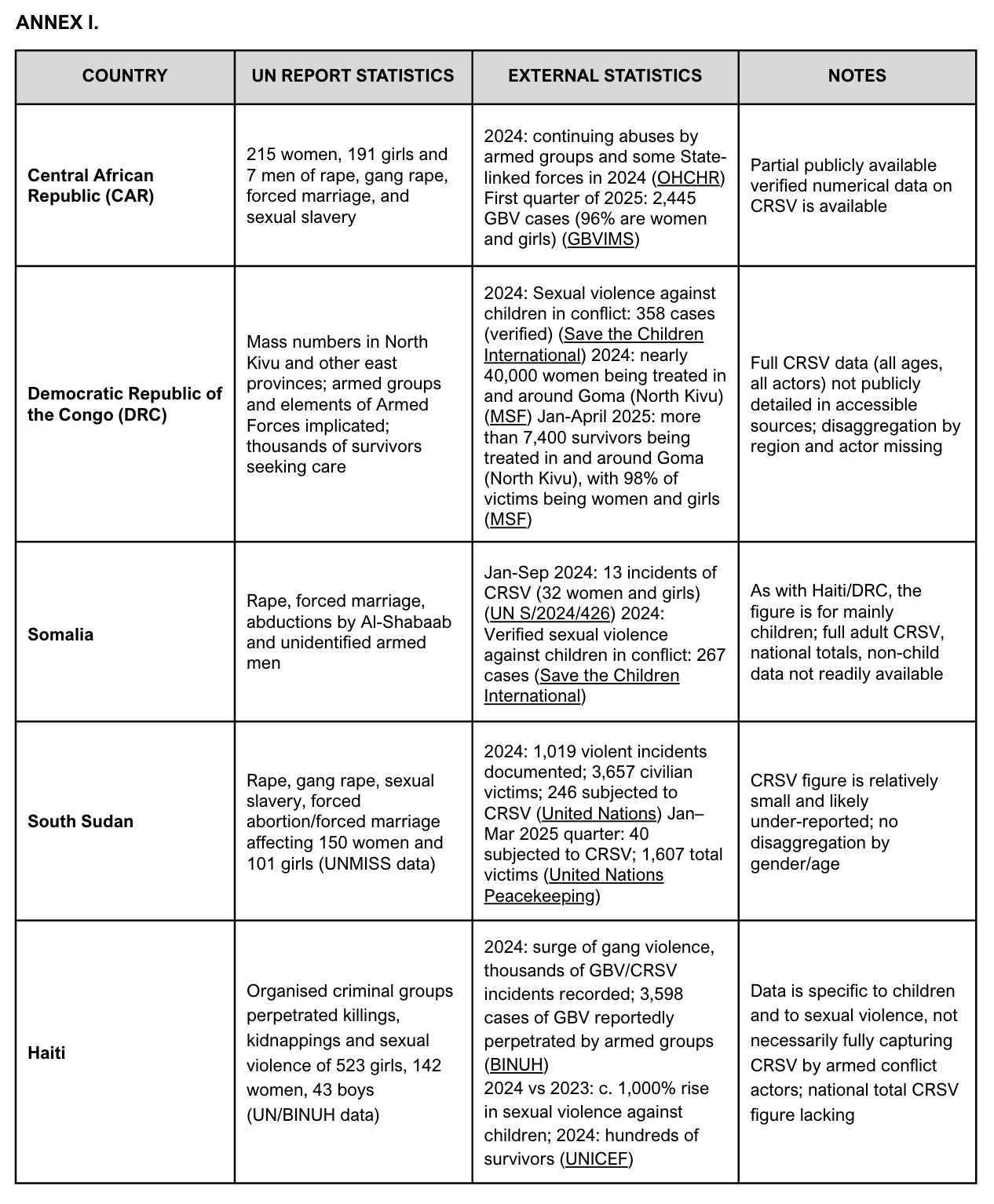
This section provides a comparative assessment of the scale, patterns, and documentation challenges surrounding CRSV in CAR, DRC, Somalia, South Sudan, and Haiti, drawing on both the UN Secretary-General’s verified findings and additional external data. It examines how the magnitude and forms of CRSV vary across contexts, highlights significant disparities in reporting and verification capacity, and illustrates how these gaps hinder accountability and impede States’ compliance with their obligations under CEDAW. A consolidated comparative table of all verified and external statistical findings is provided in Annex I.
Across all five countries, CRSV reflects widespread and often systematic patterns of abuse, while publicly accessible data remains uneven, fragmented, and heavily constrained by insecurity and underreporting. The asymmetry in data underscores broader structural challenges that impede accountability and hinder full compliance with CEDAW obligations.
CAR recorded 215 women, 191 girls, and 7 men subjected to rape, gang rape, forced marriage, and sexual slavery in UN-verified cases, alongside 2,445 GBV cases in the first quarter of 2025 alone, 96% involving women and girls (GBVIMS, 2025). These are clear breaches of Article 6 (trafficking and exploitation of prostitution) and Article 16 (forced marriage and family-related discrimination).
DRC remains the world’s largest CRSV hotspot. Medical NGOs treated nearly 40,000 survivors in 2024, with around 100 sexual violence cases per day around Goma by early 2024 (MSF, 2025). UN-verified data includes 358 CRSV cases involving children in 2024, but full national figures remain unavailable.
Somalia documented rape, abductions, and forced marriage by Al-Shabaab and armed actors, while at least 42 survivor support centres closed due to funding cuts, violating Article 3, which requires States to guarantee women’s full advancement and the institutional machinery to secure it. Verified 2024 numbers include 267 cases of sexual violence against children (Save the Children International, 2025), but no national-level adult CRSV data is publicly available.
South Sudan reported 246 CRSV survivors in 2024 (150 women, 101 girls, and several men), with an additional 40 cases between January and March 2025 (UN Peacekeeping, 2025). UNMISS noted widespread patterns of rape, gang rape, sexual slavery, and forced abortion, though real prevalence is likely much higher.
Haiti saw gangs use collective rape and sexual violence to maintain territorial control. UN/BINUH verified 523 girls, 142 women, and 43 boys subjected to sexual violence, alongside 3,598 GBV cases in 2024 attributed to armed groups.
Across all five countries, data gaps, limited service availability, weak judicial systems, and insecurity severely restrict monitoring and accountability. The prevalence and documented patterns of CRSV highlight States' continued failure to meet their CEDAW obligations to prevent, investigate, prosecute, and redress conflict-related sexual violence.
5.3. Data Gaps and Monitoring Limitations
In all five countries, data gaps reflect structural weaknesses in national protection systems. In the DRC, Somalia, and Haiti, children-specific data dominates, while adult CRSV cases remain grossly underrepresented. Disaggregated data (by gender, age, disability, ethnicity, or perpetrator) is often missing, significantly limiting accountability assessments. Some contexts lack nationwide monitoring systems, resulting in major geographic blind spots (particularly rural DRC, parts of Somalia, and remote areas of CAR). Furthermore, underreporting remains acute, especially in South Sudan and Somalia, where social stigma and threat of reprisals are high, demonstrating a breach of Article 5(a), which requires States to eliminate gender stereotypes and social norms that perpetuate discrimination and General Recommendation No. 30 on conflict prevention and accountability.
6. STRUCTURAL, POLITICAL AND INSTITUTIONAL BARRIERS TO PREVENTION AND ACCOUNTABILITY
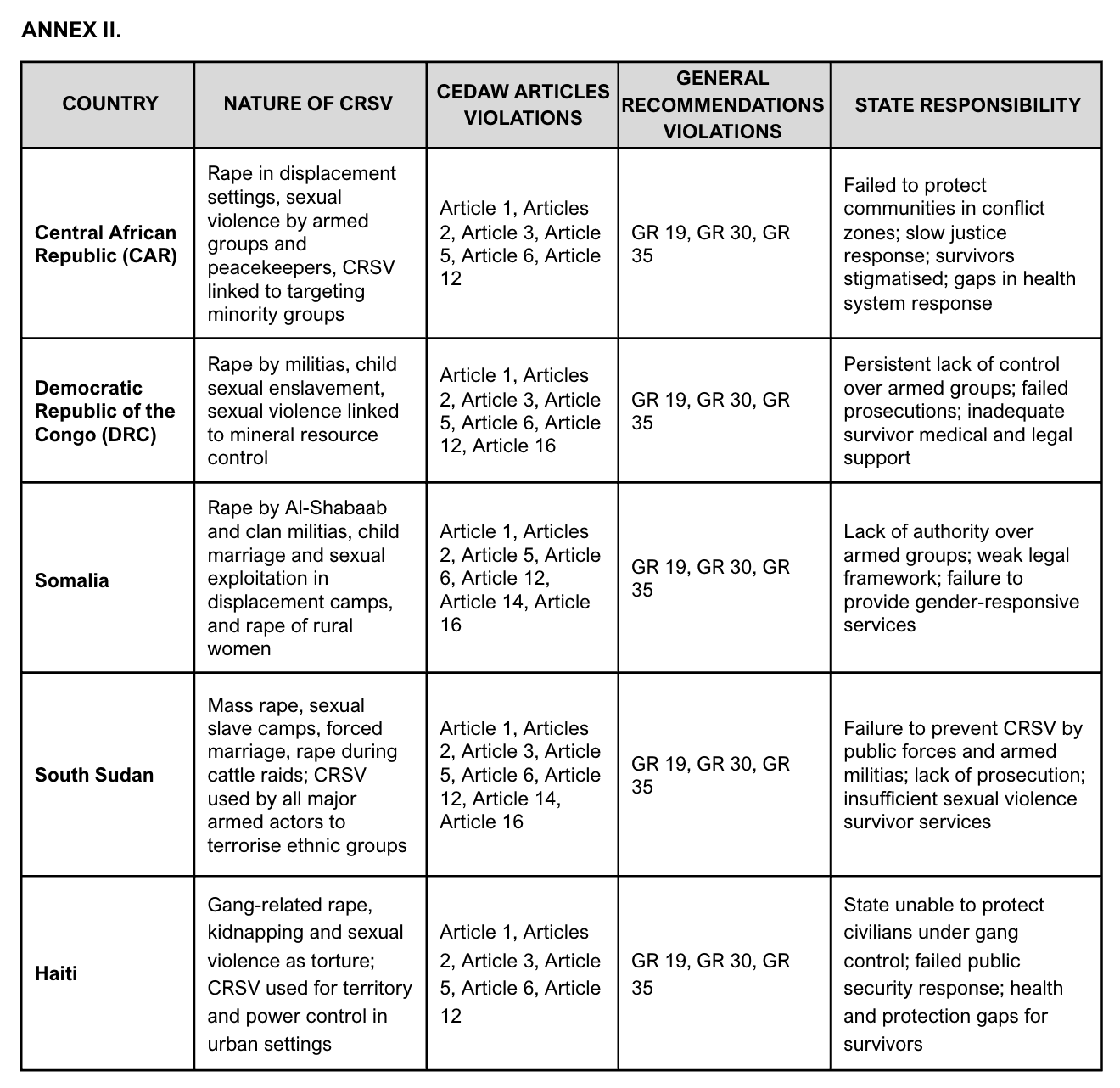
This section examines the key structural, political, and institutional barriers that prevent effective prevention, accountability, and survivor protection in CAR, DRC, Somalia, South Sudan, and Haiti, and analyses how these shortcomings constitute persistent violations of States’ obligations under CEDAW and international humanitarian and human rights law. It also highlights gaps between legal frameworks and their implementation. A comparative overview of CRSV patterns, accountability failures, and CEDAW violations across the five countries is presented in Annex II.
6.1. State Responsibility and Accountability Gaps
While state responsibility varies, a consistent pattern emerges: either direct perpetration by state agents (DRC and South Sudan) or failure to prevent and respond to CRSV by non-state actors (Haiti, Somalia). All of these reflect violations of CEDAW and international humanitarian and human rights law.
Stigma, fear, and limited services drive underreporting across the five states. In the CAR, most survivors lack access to specialised legal and medical services, especially in remote areas, constituting a breach of CEDAW Article 12 on women’s right to health and Article 2(c) requiring States to ensure effective legal protection. In the DRC, widespread insecurity and limited access to survivor services violate Article 12 (healthcare access) and Article 14, which mandates protection for rural women who disproportionately lack medical and legal assistance. In South Sudan and Somalia, services are systematically underfunded, and insecurity prevents consistent humanitarian access. In Haiti, gang control has fractured service delivery, leaving survivors with minimal access to health care or justice.
Political barriers severely limit prevention and accountability. In the CAR and parts of the DRC, state authority is weak or contested, enabling armed groups to operate freely. Haiti’s gang rule has produced zones of lawlessness, while in Somalia, fragmented governance and inconsistent legal frameworks impede protection efforts, violating Article 2(e), which obligates States to act with due diligence to prevent and respond to gender-based violence by non-State actors. In Somalia, fragmented governance and inconsistent legal frameworks impede protection efforts. Even where national action plans or reforms exist – such as CAR’s 2024–2028 plan, DRC prosecutions, Somalia’s Offences of Rape and Indecency Bill (pending finalisation), and South Sudan’s National Police Service action plan – implementation is inconsistent, under-resourced, or non-functional.
Although domestic legal frameworks criminalise rape, enforcement remains inconsistent and accountability weak, contravening Article 2(b) (adopting adequate legislation), Article 2(c) (ensuring competent tribunals), and Article 2(f) (eliminating discriminatory practices). The CAR Penal Code criminalises sexual violence but prosecutions remain rare (Human Rights Watch, 2018); the DRC’s 2006 Penal Code amendments strengthened definitions of rape, though implementation gaps persist; South Sudan’s Penal Code Act (2008) includes sexual offences but prosecutorial capacity remains extremely limited (U.S. State Department, 2024); Somalia’s Provisional Constitution and 2016 Sexual Offences Acts provide protection unevenly applied across federal member states; and while Haiti’s Penal Code criminalises rape, long-promised post-2016 reforms have stalled, leaving survivors without an effective legal framework. Overall, legal frameworks are insufficiently implemented, judicial systems remain weak, and survivors face major barriers to justice and redress.
7. ENHANCING STATE ACCOUNTABILITY IN PREVENTING AND PROTECTING CRSV SURVIVORS
This section examines both the Secretary-General’s key recommendations on State accountability for CRSV and a set of additional accountability mechanisms that go beyond the scope of the Secretary General’s report. It outlines how existing measures can be strengthened and identifies institutionally transformative tools needed to close accountability gaps in CAR, DRC, Somalia, South Sudan, and Haiti.
7.1. Key Recommendations of the Secretary General’s Report
The report proposes a wide range of different recommendations, aiming to sustain life-saving services and strengthen the global response to conflict-related sexual violence, especially in the context of UN peace operations, transitional justice processes, and ongoing conflicts across the 21 countries.
The specific common strategies, which the report recommends in the case of CAR, DRC, Somalia, South Sudan, and Haiti are centred around three main issues: 1) strengthening implementation of existing frameworks (i.e., action plans and reinforcing commitments already made in national action plans or joint communiqués); 2) improving survivor-centred services to enhance access to multisectoral services – including healthcare, psychosocial support, legal assistance, and reparations – particularly for survivors in rural, displaced, or conflict-affected areas; and 3) justice and accountability through justice sector reform or specific mechanisms, including reforming or implementing criminal laws pertaining to sexual violence, ensuring prosecution, and in some cases, expanding special courts or mobile justice systems. In the context of CAR and South Sudan, the focus is placed on completing action plans tied to the security sector. In Somalia, legal reform is highlighted due to stalled legislation. In the DRC, monitoring and protection during peacekeeping withdrawal is emphasised, while in the case of Haiti, calls for international support to enforce security and justice due to a breakdown of state authority is emphasised.
7.2. Additional Recommendations to Strengthen Accountability for CRSV
This section outlines further measures that extend beyond the Secretary General’s report’s focus on legal reform, services, justice, and sanctions. These recommendations aim to provide stronger enforcement, institutional transformation, and more robust accountability across the five countries, particularly addressing accountability mechanisms not included in the Secretary General’s report but which would significantly strengthen responses to CRSV in CAR, DRC, Somalia, South Sudan, and Haiti.
A set of strengthened accountability and enforcement tools is proposed to improve prevention, response, and justice for conflict-related sexual violence. It is recommended that independent civilian oversight bodies be established to investigate CRSV committed by police, military, and armed actors, an approach especially relevant in CAR, South Sudan, and Haiti. Mandatory national vetting systems should also be introduced to remove individuals implicated in CRSV from security and justice institutions, a priority for the DRC, Somalia, and South Sudan. Additionally, the creation of national CRSV observatories is proposed to ensure continuous, disaggregated data collection and analysis, particularly needed in CAR and the DRC.
To strengthen prosecution efforts, it is recommended that joint investigation teams with the ICC and regional bodies be established to support evidence collection and enhance cross-border accountability, particularly for CAR, the DRC, and South Sudan. Furthermore, it is proposed that international funding, military assistance, and training be made conditional on measurable reductions in CRSV and demonstrable State action to investigate and prosecute crimes, an approach especially applicable to Somalia and Haiti. The use of targeted regional sanctions by the African Union (AU) and Organisation of American States (OAS) is also encouraged to reinforce compliance, notably for the CAR, the DRC, and Haiti.
Additional measures include the adoption of CRSV-specific witness protection frameworks, with relocation and anonymity guarantees to ensure survivor safety, particularly in Haiti and Somalia. Peace processes in the five contexts should incorporate compulsory anti-CRSV provisions, prohibit amnesties, and ensure participation of women’s organisations, as relevant in South Sudan, CAR, and Somalia. Finally, the establishment of long-term, State-funded reparations programmes covering healthcare, psychosocial support, education, and livelihoods for survivors and children born of wartime rape is recommended, especially for the CAR and the DRC. Integrating these strategies would substantially strengthen global enforcement, institutional compliance, and State accountability for CRSV.
8. CONCLUSION
Conflict-related sexual violence (CRSV) in CAR, DRC, Somalia, South Sudan, and Haiti demonstrates persistent and serious violations of the CEDAW Convention. Across all five contexts, CRSV is not an isolated byproduct of conflict but a manifestation of entrenched discrimination, gendered power imbalances, and structural inequality – conditions that States are obligated to eliminate under Articles 2, 3, 5 and 12, reinforced by General Recommendations 19, 30, and 35. Despite decades of UN Security Council resolutions recognising sexual violence as a threat to peace and security, State and non-State actors continue to operate with near-total impunity, and the measures taken to prevent, investigate, punish, and remedy CRSV remain gravely inadequate.
The patterns identified – widespread perpetration by armed groups and security forces (DRC, South Sudan, CAR, Somalia), State failure to protect against gang-led sexual violence (Haiti), discriminatory norms that silence survivors, and severe gaps in essential health and psychosocial services – represent clear breaches of the State due diligence obligation to prevent, address, and resolve GBV. These failures also reflect deeper structural discrimination that contravenes Articles 2(e) and 5(a), including harmful gender stereotypes, social stigma, and tolerance of violence within justice, security and customary systems. As highlighted throughout this report, even where domestic legal frameworks criminalise sexual violence, enforcement remains inconsistent, inaccessible, or effectively absent.
Situating these five cases within the broader dataset of 21 countries reveals that the underlying drivers of CRSV – weak institutions, discriminatory social norms, fragmented accountability mechanisms, and chronic insecurity – are not unique, but symptomatic of systemic non-compliance with CEDAW obligations in conflict-affected and fragile settings. The widespread impunity documented across all countries underscores the urgent need for States to implement the obligations enumerated in General Recommendation 30, particularly regarding vetting of security forces, integration of gender perspectives in peace processes, protection of women human rights defenders, and guarantees of non-repetition through structural reform.
To meet their obligations under CEDAW, States must urgently strengthen legal and institutional frameworks; ensure independent, survivor-centred investigations and prosecutions; expand access to comprehensive health, psychosocial and legal services; and dismantle discriminatory norms that perpetuate violence and silence survivors. These measures are not optional policy preferences: they are legally binding human rights duties. Integrating CEDAW systematically into national CRSV action plans, peace processes, security-sector reform, and humanitarian response represents a critical pathway to closing the persistent accountability gap identified in this report.
Ultimately, the evidence demonstrates that CRSV persists where gender discrimination is entrenched, institutions are weak, and perpetrators operate without fear of consequence in the five contexts. Fully implementing CEDAW provides States with a concrete, enforceable framework to transform this reality. Without urgent, rights-based structural reforms grounded in CEDAW obligations, efforts to prevent and respond to CRSV will continue to fall short.
ACTIVE CEDAW VIOLATION
CEDAW AND EVALUATING STATE ACCOUNTABILITY FOR CONFLICT-RELATED SEXUAL VIOLENCE (2024–2025) IN THE CENTRAL AFRICAN REPUBLIC, THE DEMOCRATIC REPUBLIC OF THE CONGO, SOMALIA, SOUTH SUDAN, AND HAITI
Dated: 12 January 2026
In response to the 2025 UN Secretary-General’s Report (S/2025/389), this submission evaluates the five most affected contexts – CAR, DRC, Somalia, South Sudan, and Haiti – and finds clear and widespread violations of CEDAW Articles 2, 3, 5, 6, 12, 14, and 16. Across all settings, state authorities either perpetrate CRSV directly or fail to exercise due diligence to prevent and respond to abuses by non-state actors. Data from UN and humanitarian sources reveal severe patterns: CAR documented at least 413 UN-verified CRSV survivors; DRC registered tens of thousands of medical CRSV cases in 2023–2024; Somalia verified 267 cases of child sexual violence; South Sudan recorded 246 CRSV survivors in 2024; and Haiti reported over 3,598 gender-based violence (GBV) incidents linked to gangs, with hundreds of verified CRSV survivors. Structural barriers – including weak justice systems, lack of forensic and medical capacity, insecurity, underfunded survivor services, stalled legal reforms, and contested territorial control – undermine accountability efforts. In all contexts, monitoring gaps and lack of disaggregated data impede a full assessment of CRSV prevalence.
Authored by Dr Bianka Vida, a Research Analyst at IWI, as well as a political scientist and gender equality specialist with nearly ten years of experience in EU and international human rights, gender politics, and comparative politics. She has a proven record in designing and implementing research projects, producing evidence-based policy reports and actionable policy recommendations, and engaging with EU institutions, governmental bodies, NGOs, and academia. Dr Vida is a published researcher and conference presenter with a strong commitment to advancing gender-inclusive democracy, shaping policy reform, and promoting social justice through rigorous research and active multilateral engagement.
DISCLAIMER AND COPYRIGHT
This document is prepared for, and addressed to, 9th Secretary-General of the United Nations António Guterres, the Members and staff of the United Nations (UN) as background material to assist them in their parliamentary work. The content of the document is the sole responsibility of its author(s) and any opinions expressed herein should not be taken to represent an official opinion of the United Nations or its agencies.
Reproduction and translation for non-commercial purposes are authorised, provided the source is acknowledged and The IWI: International Women’s Initiative is given prior notice and sent a copy.
BINUH (2024) Quarterly report on the Human Rights Situation in Haiti, October – December 2024. Accessed 6 November 2025. https://binuh.unmissions.org/sites/default/files/human_rights_quarterly_report_-_october-december_2024_-_en.pdf.
Gender-Based Violence Information Management System (GBVIMS) (2025) GBVIMS first quarter trend analysis: Central African Republic (Q1 2025)
Human Rights Watch (2017) ‘They Said We Are Their Slaves’ Sexual Violence by Armed Groups in the Central African Republic. Accessed 4 November 2025. https://www.hrw.org/report/2017/10/05/they-said-we-are-their-slaves/sexual-violence-armed-groups-central-african.
Médecins Sans Frontières (MSF) (2024)’We treat more than 100 survivors per day’: Sexual violence in and around Goma. Accessed 11 November 2025. https://www.msf.org/women-eastern-drc-nowhere-safe-sexual-violence.
Office of the High Commissioner for Human Rights (OHCHR) & United Nations Assistance Mission in Somalia (UNSOM) (2024) Human rights and protection concerns in Somalia.
Physicians for Human Rights (PHR) (2024) ‘Massive Influx of Cases’: Health Worker Perspectives on Conflict-Related Sexual Violence in Eastern Democratic Republic of the Congo. Accessed 6 November 2025. https://phr.org/our-work/resources/massive-influx-of-cases-sexual-violence-drc/.
Save the Children International (2025) Sexual violence against children in conflict surges 50% in 5 years to the worst level ever (Haiti). Accessed 6 November 2025. https://www.savethechildren.net/news/sexual-violence-against-children-conflict-surges-50-5-years-worst-level-ever.
UNICEF (2024) Child sexual violence surge in Haiti: Situation overview. UNICEF Haiti Office.
United Nations (2025) Report of the Secretary-General on conflict-related sexual violence (S/2025/389). United Nations Security Council.
United Nations. (2024). Report of the Secretary-General on the situation in Somalia (S/2024/426). United Nations Assistance Mission in Somalia. Accessed 7 November 2025. https://unsom.unmissions.org/sites/default/files/s_2024_426-en.pdf.
United Nations Human Rights Council (2022) Report of the United Nations High Commissioner for Human Rights: Haiti – Human rights situation and challenges. United Nations Human Rights Council.
United Nations Mission in South Sudan (UNMISS) (2024) Human rights division quarterly brief: Conflict-related sexual violence in South Sudan.
United Nations Mission in South Sudan (UNMISS) (2025) Human rights violations and abuses (January–March 2025).
United Nations Peacekeeping (2025) Violence against civilians surges amidst escalating conflict in South Sudan (January – March 2025). Accessed 10 November 2025. https://peacekeeping.un.org/en/violence-against-civilians-surges-amidst-escalating-conflict-south-sudan-january-march-2025.
United Nations Security Council (2000) Resolution 1325 (Women, Peace and Security). United Nations.
United Nations Security Council (2019) Resolution 2467 (Sexual violence in conflict). United Nations.
United Nations Security Council / OHCHR (2025) Central African Republic: UN report calls for accountability for attacks by armed groups active in Haut Oubangui. Accessed 11 November 2025. https://www.ohchr.org/en/press-releases/2025/03/central-african-republic-un-report-calls-accountability-attacks-armed-groups.
U.S. Department of State (2024) 2024 Country reports on human rights practices: South Sudan. U.S. Department of State. Accessed 6 November 2025. https://www.state.gov/reports/2024-country-reports-on-human-rights-practices/south-sudan.
ACTIVE CEDAW VIOLATION CEDAW and Evaluating State Accountability for Conflict-Related Sexual Violence (2024–2025) in the Central African Republic, the Democratic Republic of the Congo, Somalia, South Sudan, and Haiti