
emergency alert
Escalating Attacks on Women Human Rights Defenders and Widespread Gender-Based Violence in Iran (Late 2025 – Current)
A Call to Global Conscience
Immediate global attention and accountability are required
The situation in Iran has deteriorated sharply since late 2025, putting women and girls at unprecedented risk of harm, detention, and death. Women human rights defenders (WHRDs) – including students, journalists, lawyers, and community leaders – have increasingly faced arbitrary arrest, incommunicado detention, judicial harassment, and threats of violence directly linked to their activism.
In December 2025, a 23-year-old student activist in Tehran, documenting injuries sustained by protesters, was arrested without access to legal counsel. During detention, she was interrogated regarding her social media activity and affiliations with human rights organisations, illustrating reprisals against women for exercising freedom of expression and assembly. In Western Iran, a Kurdish woman community organiser providing legal assistance to families of protest victims was detained with two colleagues, held in solitary confinement, and denied family visits, reflecting intersectional targeting of ethnic minority WHRDs and gendered reprisals for advocacy.
In late 2025, a woman journalist reporting on femicide and enforcement of compulsory hijab laws was arrested and charged with ‘propaganda against the state’ and ‘immorality’, demonstrating the criminalisation of women documenting structural violence. Moreover, a mother advocating for justice following her daughter’s killing in protests was detained for several weeks in Tehran, exemplifying that women acting as informal human rights defenders are also systematically targeted.
These cases constitute violations of CEDAW Articles 1, 2(c), 3, 7, and 10, and are reinforced by General Recommendations No. 19 (violence against women), 23 (women in political and public life), 28 (core state obligations), 33 (access to justice), and 35 (gender-based violence against women).
Impact of Repression on Women and Women Human Rights Defenders
Survivor and family testimonies illustrate the human impact of this repression. The family of a 23-year-old Kurdish student shot in the head by security forces during protests in Tehran described her as ‘thirsty for freedom and women’s rights’, and her mother stated, ‘It wasn’t just my daughter; I saw hundreds of bodies with my own eyes…’, yet authorities denied the family permission to bury her at home, forcing interment along the roadside (Iran Human Rights, 2026). Eyewitnesses in Kurdish regions reported, ‘They are killing us’ as security forces beat and shot at women demonstrators, with some sustaining injuries that prevented them from standing (The Guardian, 2026).
UN investigators documented that survivors and families seeking justice are systematically harassed, intimidated, and denied the right to mourn, and women detained in relation to protests have reported sexual assault and torture while in custody (Amnesty International, 2023).
These targeted attacks against WHRDs occur in the context of a nationwide protest wave that began in late December 2025 and spread to approximately 200 cities. Death toll in crackdown on protests in Iran spikes to at least 538, activists say – reported by multiple news outlets citing the Human Rights Activists News Agency’s (HRANA) figures, which notes that at least 538 people were killed and over 10,600 detained detained during nationwide protests as of early January 2026 (WRAL News, 2026). These figures reflect minimum verified numbers for a specific point in time during an ongoing crisis with significant information gaps due to internet blackouts and reporting constraints. The later reports indicate that death toll estimates may have risen, for instance, 646 (HRANA, cited in Anadolu Agency, 2026), or even over 2,000 in other NGO compilations (Iran International, cited in The Jerusalem Post, 2026). Women were disproportionately affected, including those participating in demonstrations and those documenting abuses.
The UN Independent International Fact-Finding Mission on Iran confirmed that authorities employed excessive and targeted force against protesters, including women, and subjected WHRDs to arbitrary detention, harassment, and torture, indicating crimes against humanity (UN Fact-Finding Mission, cited in Amnesty International, 2025).
Gender-Based Violence, Femicide, and Judicial Discrimination
The systematic repression of WHRDs intersects with a longstanding pattern of gender-based violence. Independent monitoring by the Hengaw Organisation documented at least 207 femicide cases in 2025, many committed by intimate partners or relatives, reflecting deeply entrenched structural violence (Hengaw, 2025). At least 45 women were executed during the same period, marking an 88% increase from previous years, with many facing harsh judicial sentences for morality-related offenses (Hengaw, 2025; UNOG, 2025a).
Women who documented abuses or protested gender-based violence were disproportionately targeted, demonstrating systematic judicial and state discrimination in violation of CEDAW Articles 2 and 5, as highlighted by General Recommendations 19 and 28.
Divergence Between Official National Data and Independent and United Nations Findings
Independent and UN-verified sources consistently reveal a far more severe reality than Iranian national reports suggest. Hengaw documented 207 femicide cases in 2025, yet official national sources rarely acknowledge these deaths, instead categorising them as ordinary criminal incidents and omitting their gendered nature. Similarly, HRANA reported over 538 deaths during protests between late 2025 and January 2026, while Iranian state media minimised fatalities, reporting only ‘dozens’.
Arrest figures also diverge: independent monitoring identified more than 10,600 detentions in this period, with women disproportionately targeted for activism and documentation, while state sources suggest only a few hundred arrests and provide no gender breakdown. Executions of women further illustrate these discrepancies: independent sources recorded at least 45 executions in 2025, many for morality-related offenses, whereas official reporting often omits both gender-specific information and context for these sentences.
Sexual violence and ill-treatment in detention, particularly targeting WHRDs, has been documented by Amnesty International and the UN Fact-Finding Mission, yet Iranian authorities rarely acknowledge these abuses. This divergence highlights the importance of relying on independent and UN-verified sources to fully assess the scope and gendered nature of violence, and it underscores systemic underreporting by state authorities, which obscures the real risks faced by women and WHRDs.
Official United Nations reports further confirm the structural nature of these violations. The Independent Fact-Finding Mission reported murder, arbitrary detention, torture, sexual violence, and persecution of women and WHRDs, noting that discrimination against women and girls acted as both a trigger and enabler of abuses (UN Fact-Finding Mission, cited in Amnesty International, 2025). Survivors report ongoing threats and harassment for attempting to document abuses or seek accountability (UNOG Newsroom, 2025b). Amnesty International documented cases of sexual assault and ill-treatment of women in detention, further highlighting systemic patterns of violence against WHRDs (Amnesty International, 2023).
The cumulative effect of targeted repression, rising femicide, disproportionate judicial violence, structural discrimination, and underreporting represent an urgent crisis requiring immediate intervention. The persecution of WHRDs illustrates both immediate threats to individual women and a broader collapse of protections for women and girls in Iran, engaging violations of CEDAW Articles 1, 2, 3, 5, 7, 10, and 12 and General Recommendations 19, 23, 28, 33, and 35.
The following recommendations are grounded in States’ obligations under CEDAW, in particular Articles 2, 5, 12 and 16, and General Recommendations Nos. 19, 24, 30 and 35.
State Parties to CEDAW
State Parties should act collectively to uphold CEDAW standards by:
1. Publicly condemning attacks on WHRDs and calling on Iran to comply with its obligations under the Convention
2. Applying diplomatic pressure and monitoring measures to secure the release of arbitrarily detained WHRDs and ensure the safety of women protesters
3. Supporting the collection and dissemination of gender-disaggregated data on arrests, killings, executions, and femicides, while highlighting discrepancies with official state figures
The Government and State Authorities of Iran
Iranian authorities are urged to take immediate action, in line with universally recognised human rights standards, including:
1. Releasing all women detained solely for peaceful activism, protest participation, documentation of abuses, or women’s rights advocacy
2. Ensuring accountability for state actors responsible for lethal force, torture, sexual violence, enforced disappearance, and arbitrary detention of women and girls
3. Guaranteeing survivors’ and families’ rights to document violations, mourn, seek truth and justice, and access remedies without intimidation or retaliation
4. Undertaking urgent legal and institutional reforms to eliminate systemic discrimination against women, including laws and practices that restrict expression, assembly, and association or perpetuate impunity for gender-based violence and femicide
5. Aligning domestic laws and practices with binding international human rights obligations, including the ICCPR and customary international law, and responding to findings and recommendations of UN human rights mechanisms, notwithstanding Iran’s non-ratification of CEDAW
International, Regional, and National Human Rights and Women’s Rights Organisations, and Organisations Supporting WHRDs These actors are urged to pursue coordinated and sustained action by:
1. Providing protection-oriented support to WHRDs and women at risk, including legal aid, psychosocial assistance, emergency support, and protection or relocation measures where necessary
2. Documenting and preserving evidence of gender-based violations against women and WHRDs in accordance with international and survivor-centred standards
3. Collecting and disseminating gender-disaggregated data on killings, arrests, executions, femicides, and other abuses, while contextualising discrepancies between official and independent or UN-verified figures
4. Amplifying survivor testimonies and case studies, with informed consent and safeguards, to centre women’s lived experiences in advocacy, accountability, and UN reporting processes
5. Engaging with UN human rights mechanisms, including the CEDAW Committee, Special Procedures, and the Independent International Fact-Finding Mission on Iran, and advocating for international accountability measures, including sanctions, investigations, and universal jurisdiction where applicable
The targeting of WHRDs, rising femicide, disproportionate judicial violence, entrenched structural discrimination, and systematic underreporting constitute an acute and escalating crisis requiring urgent intervention by the CEDAW Committee.
Methodological Note
All quantitative figures cited in this emergency alert and reflected in the annex represent minimum verified numbers reported by independent human rights organisations, UN mechanisms, and credible media outlets at the time of documentation (late 2025 – mid-January 2026). Due to severe restrictions on access to information, internet shutdowns, intimidation of families and witnesses, and systemic underreporting by state authorities, the true scale of violations is likely significantly higher. The figures should therefore be understood as conservative estimates, consistent with UN human rights reporting standards.
ANNEX: Mapping of Documented Violations Against Women and WHRDs to CEDAW Articles and General Recommendations
This annex provides a non-exhaustive mapping of documented violations against women and women human rights defenders to relevant provisions of the Convention and applicable General Recommendations. The examples and statistics summarised below are drawn from verified documentation referenced in the main text and illustrate patterns of gender-based discrimination and violence rather than isolated incidents. Statistics are indicative and reflect minimum documented figures.
(10 February 2026)
CEDAW-Based Calls to Action
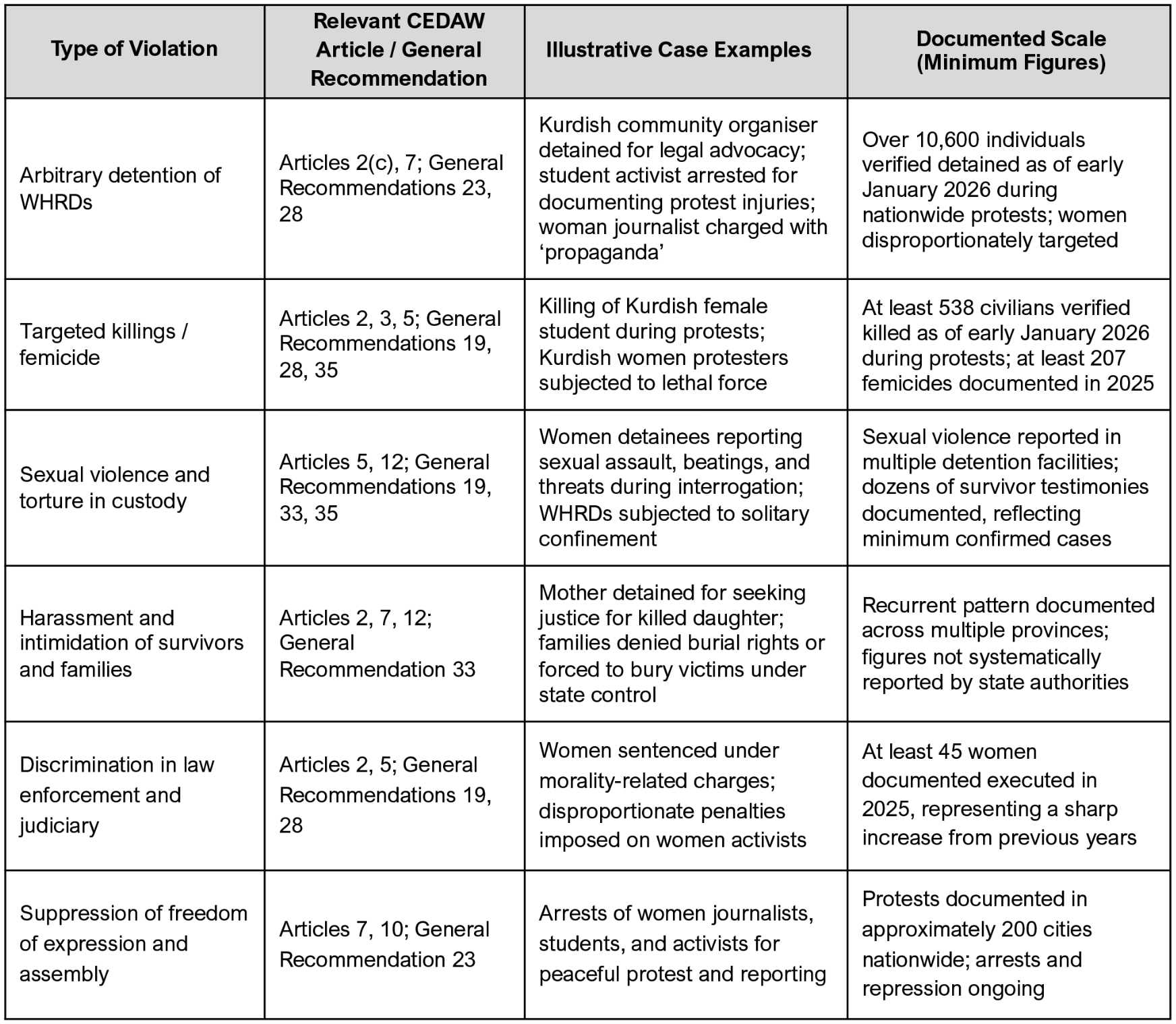
Taken together, these documented patterns demonstrate widespread and systemic violations of women’s rights and the targeting of WHRDs, engaging multiple provisions of the Convention and reinforcing the need for urgent action by the Committee.
References
Amnesty International (2023) ‘They Violently Raped Me’ – Sexual Violence Weaponised to Crush Iran’s ‘Woman Life Freedom’ Uprising. Accessed 11 January 2026. https://www.amnesty.org/en/wp-content/uploads/2023/12/MDE1374802023ENGLISH.pdf.
Anadolu Agency (2026) Death Toll Climbs to 645 as Iran Protests Continue: Report. 13 January 2026. Accessed 13 January 2026. https://www.aa.com.tr/en/middle-east/death-toll-climbs-to-645-as-iran-protests-continue-report/3797597.
Hengaw Organisation for Human Rights. (2025) Hengaw’s 2025 Report — 176 Femicides and Systematic Violations of Women’s Rights in Iran. Accessed 11 January 2026. https://hengaw.net/en/reports-and-statistics-1/2025/11/article-4
Iran Human Rights (2026) Iran Protests: Rubina (23) Shot in Head; ‘It Wasn’t Just My Daughter, I Saw Hundreds of Bodies with My Own Eyes’. 10 January 2026. Accessed 11 January 2026. https://iranhr.net/en/articles/8525/.
The Guardian (2026) They are Killing Us: Authorities Use Force against Protesters in Kurdish Regions of Iran. 7 January 2026. Accessed 10 January 2026. https://www.theguardian.com/world/2026/jan/07/they-are-killing-us-authorities-use-force-against-protesters-in-kurdish-regions-of-iran.
The Jerusalem Post (2026) Over 12,000 Estimated Dead in Iran Mass Killings, Largely Over Two Nights, Amid Protests – Report. 13 January 2026. Accessed 13 January 2026. https://www.jpost.com/middle-east/iran-news/article-883190.
UN Office at Geneva (UNOG) Newsroom (2025b) HRC58 – Human Rights in Iran – 18 March 2025. Accessed 11 January 2026. https://www.unognewsroom.org/story/en/2569/hrc58-human-rights-in-iran-18-march-2025.
UN Office at Geneva (UNOG) Newsroom (2025a) Human Rights Council Hears Alarming Updates on Executions in Iran and Global Civic Space Crackdown. Accessed 11 January 2026. https://news.un.org/en/story/2025/06/1164586.
United Nations Independent International Fact‑Finding Mission on Iran (2025) Report on Human Rights Abuses and Discrimination. Accessed 11 January 2026 via Amnesty International (2025) Iran: UN Expands Fact-Finding Mission’s Mandate in Landmark Development to Address Human Rights Crisis. https://www.amnesty.org/en/latest/news/2025/04/iran-un-expands-fact-finding-missions-mandate-in-landmark-development-to-address-human-rights-crisis/.
United Nations Human Rights Council (UN HRC) (2025) Updates on Executions in Iran and Human Rights Concerns. Retrieved from https://www.ungeneva.org/en/news-media/news/2025/06/107523/human-rights-council-hears-alarming-updates-executions-iran-and?utm_source=chatgpt.com
WRAL News (2026) Death Toll in Crackdown on Protests in Iran Spikes to at Least 538, Activists Say. 11 January 2026. Accessed 12 January 2026. https://www.wral.com/news/ap/ae5ad-death-toll-in-crackdown-on-protests-in-iran-spikes-to-at-least-538-activists-say/.
Escalating Attacks on Women Human Rights Defenders and Widespread Gender-Based Violence in Iran (Late 2025 – Current)
EMERGENCY ALERT