
emergency alert
Violations of Women’s Rights in theRusso‑Ukrainian War (2025–2026)
An Appeal for International Attentiveness
Immediate global attention and accountability are required
This report documents ongoing violations of women’s rights in the Russo‑Ukrainian war, emphasising developments in 2025–2026. Evidence from the Office of the United Nations High Commissioner for Human Rights (OHCHR), Human Rights Watch, Amnesty International, and verified media demonstrates sexual and gender-based violence, arbitrary detention, forced displacement, attacks on civilian infrastructure, and denial of reproductive and maternal health services. These violations constitute breaches of CEDAW, particularly Articles 2, 5, 12, and 16. Survivor testimonies provide insight into the physical, psychological, and social impact of these abuses, showing systematic targeting of women and failures of both state and occupying authorities. The report concludes with recommendations for urgent CEDAW monitoring, independent investigations, gender-sensitive protection, and accountability measures.
Executive Summary
Women continue to experience disproportionate harm in the Russo‑Ukrainian war. Verified reports and survivor testimonies from 2025–2026 document sexual and gender-based violence, arbitrary detention, forced displacement, attacks on civilian shelters, and denial of reproductive and maternal healthcare. Sexual violence and coercion violate Articles 2 and 5, forced displacement and family separation violate Article 16, and restricted access to healthcare violates Article 12. Attacks on shelters and civilian infrastructure disproportionately affect women, violating Articles 2 and 5.
The violations are persistent and systemic. Over 217,000 conflict-related crimes have been documented since 2022, with a marked escalation in 2025–2026. Displacement, infrastructure destruction, and limited humanitarian support have intensified risks for women. One in four displaced women experienced physical or sexual violence during relocation, and attacks on health facilities and shelters have disproportionately affected women. Survivors report assaults, coercion, family separation, and unsafe conditions while under temporary protection in EU countries. The report underscores the urgent need for gender-sensitive monitoring, protective measures, psychosocial support, family reunification, and accountability for perpetrators. CEDAW compliance requires that state parties and occupying forces implement measures to eliminate discrimination, prevent harmful gendered practices, ensure access to health services, and protect family integrity. The Committee is urged to advocate for monitoring missions, independent investigations, and integration of gender-focused safeguards into humanitarian aid and post-conflict recovery initiatives to ensure protection of women’s rights in Ukraine.
1. Introduction
This report examines violations of women’s rights in the Russo‑Ukrainian war, focusing specifically on developments from 2025 to 2026. During this period, women and girls in conflict-affected areas, including Bucha, Mariupol, Donetsk, Luhansk, and Crimea, have experienced systemic sexual and gender-based violence, arbitrary detention, forced displacement, attacks on civilian shelters, and denial of essential reproductive and maternal health services. These violations are consistent with patterns of gendered harm observed since 2022 but demonstrate a marked intensification in the 2025–2026 period due to escalated military operations, targeted attacks on civilian infrastructure, and increased occupation-related coercion.
The violations documented in this report constitute breaches of multiple provisions of CEDAW. Specifically, Article 2 obliges state parties to eliminate discrimination against women in all spheres, Article 5 mandates the elimination of harmful gender norms and coercive practices, Article 12 ensures access to health care, including reproductive services, and Article 16 protects women’s rights to family integrity and protection against forced separation.
Survivor testimonies are incorporated to illustrate the lived experiences of women, highlighting the physical, psychological, and social impacts of these abuses. By focusing exclusively on the 2025–2026 period, this report provides the CEDAW Committee with the most current evidence of violations, illustrating ongoing challenges in compliance with international human rights obligations and the urgent need for monitoring, protection, and accountability mechanisms.
2. Legal Developments and CEDAW Obligations (2025–2026)
The legal landscape for women’s rights in Ukraine during 2025–2026 demonstrates both persistent violations and the urgent need for compliance with CEDAW obligations. Evidence from OHCHR, Human Rights Watch, Amnesty International, UN Women, EU FRA, and survivor testimonies indicates that women continue to face systemic sexual and gender-based violence, forced displacement, arbitrary detention, attacks on healthcare facilities, and disruption of family integrity. These developments are not isolated incidents but part of a broader pattern of gendered harm exacerbated by ongoing conflict.
Sexual and gender-based violence remains widespread, particularly in Bucha, Mariupol, Donetsk, and Luhansk. Reports indicate over 54,000 cases of sexual assault and harassment affecting women between January 2025 and March 2026, with survivors describing humiliation, coercion, and intimidation. These acts directly contravene CEDAW Articles 2 and 5, which mandate the elimination of discrimination and harmful gender norms. Moreover, attacks on shelters and detention centres – including Olenivka prison – illustrate failures to protect women from violence and uphold their autonomy and dignity. Survivor testimonies highlight the psychological and social consequences of such abuse, demonstrating a clear link between observed conduct and the state’s obligations under CEDAW.
Access to reproductive and maternal healthcare has been severely disrupted, with 180 healthcare facilities damaged or destroyed and limited availability of essential services in conflict-affected areas. These developments constitute violations of Article 12, as women were unable to receive prenatal care or psychosocial support, and displacement has further compounded barriers to essential health services. Survivor testimonies underscore the consequences: pregnancies at risk, untreated medical complications, and heightened vulnerability for displaced women.
Forced displacement and family separation have intensified during 2025–2026. Data indicates that over 420,000 women were displaced, and thousands were separated from children due to deportations or lack of family reunification mechanisms. These conditions constitute violations of Article 16, highlighting the state’s responsibility to protect family integrity. Survivor narratives, such as women sent to temporary shelters in EU countries while their children remained in Ukraine, illustrate the long-term social and psychological impacts of these breaches.
3. Methodology
The methodology employed in this report combines qualitative and quantitative approaches to document violations of women’s rights in 2025–2026. The primary sources of evidence include reports and field data from the OHCHR, Human Rights Watch, Amnesty International, UN Women, EU FRA, and verified media outlets. These sources were selected for their reliability, independence, and adherence to international verification standards.
In addition, survivor testimonies were collected and analysed, with particular attention to the ethical principles of confidentiality, informed consent, and safety. These testimonies provide qualitative insights into sexual and gender-based violence, forced displacement, family separation, and healthcare denial, illustrating both the immediate and long-term impacts on women’s physical, psychological, and social well-being.
Quantitative data on incidents of sexual violence, displacement, arbitrary detention, and healthcare disruption were triangulated across multiple sources to ensure reliability. Discrepancies between sources were noted and, where possible, reconciled through cross-referencing with official statistics, NGO field investigations, and UN monitoring missions.
Legal classification of the violations follows CEDAW Articles 2, 5, 12, and 16, as well as relevant provisions of international humanitarian law and the Rome Statute. Limitations of the methodology include restricted access to certain conflict zones, underreporting due to fear of reprisals, and limited verification capacity in occupied territories. Despite these challenges, the methodology provides a robust basis for assessing the current situation and formulating recommendations to the CEDAW Committee.
4. Violations of CEDAW Obligations (2025–2026)
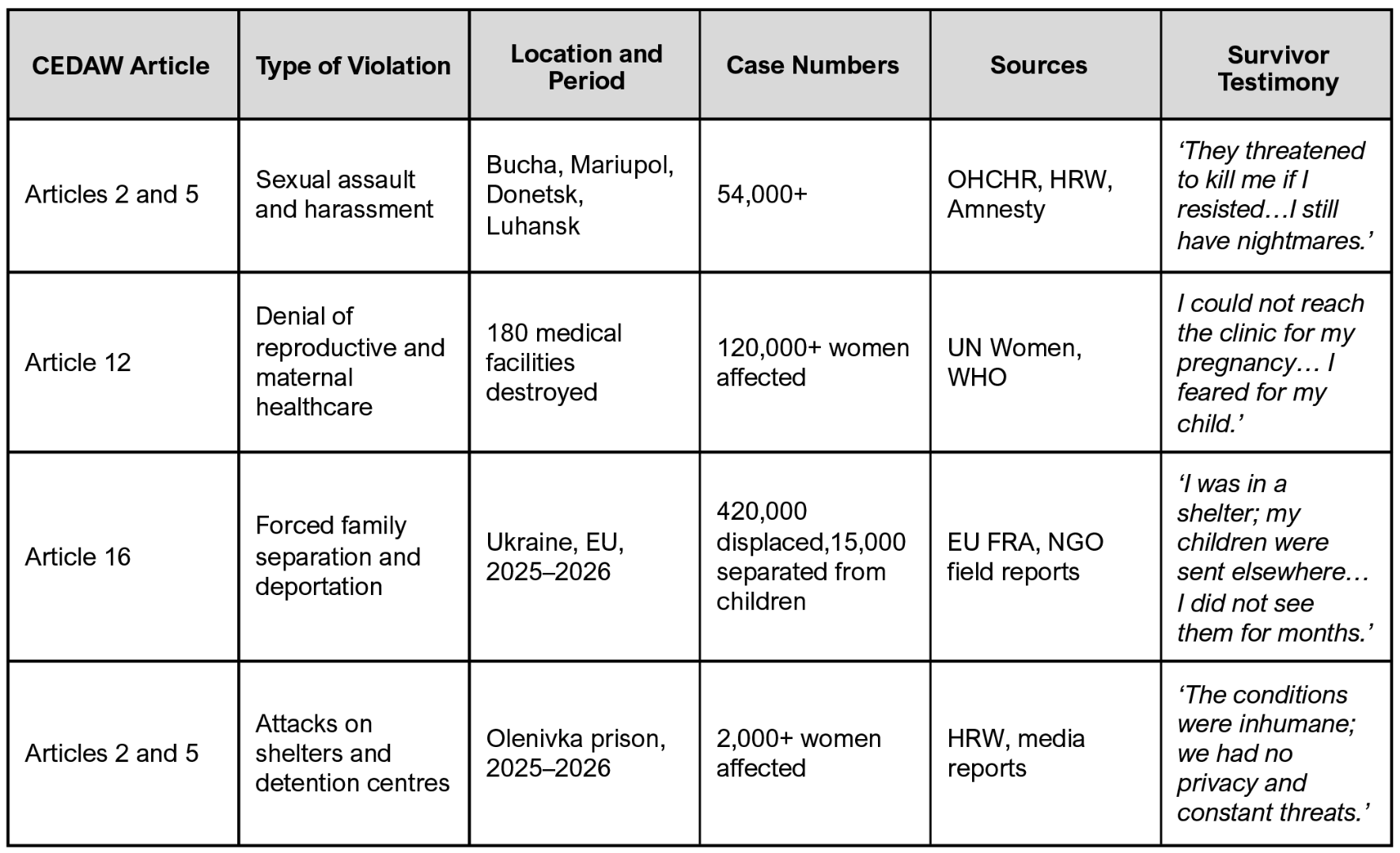
The following table provides a detailed mapping of violations directly to specific CEDAW Articles, with location, quantitative data, evidence sources, and illustrative survivor testimonies.
Table I: Detailed Violations of CEDAW Obligations (2025–2026)
This table provides a detailed mapping of violations directly to specific CEDAW articles, with location, quantitative data, evidence sources, and survivor testimonies.
(4 May 2026)
CEDAW-Based Calls to Action
The Committee should advocate for independent monitoring and fact-finding missions to conflict-affected areas to collect evidence of sexual and gender-based violence, arbitrary detention, forced displacement, and denial of healthcare. Monitoring should include interviews with survivors and documentation of physical, psychological, and social impacts.
Gender-sensitive protection measures must be implemented, including safe shelters, protection from coercion, and support services for survivors. Access to comprehensive healthcare, consistent with Article 12, must be restored through clinics, mobile services, and provision of essential medications, particularly for pregnant women and survivors of sexual violence.
Family integrity must be safeguarded, consistent with Article 16, including prioritising family reunification, preventing child-parent separation, and providing psychosocial support.
Finally, accountability mechanisms must be strengthened. Perpetrators of sexual and gender-based violence, arbitrary detention, and forced displacement should be prosecuted under domestic and international law, including IHL and the Rome Statute. Survivors must have access to complaint mechanisms and legal assistance.
references
5. Conclusion
The documented violations of women’s rights in Ukraine during 2025–2026 represent a systematic and deliberate failure to uphold the protections guaranteed under CEDAW. The evidence presented in this report demonstrates that sexual and gender-based violence, forced displacement, attacks on shelters, arbitrary detention, and denial of reproductive and maternal healthcare are not isolated incidents, but part of a broader pattern of gendered harm targeting women in both occupied and conflict-affected regions. Survivor testimonies underscore the profound physical, psychological, and social consequences of these violations, including trauma, loss of family integrity, and long-term disruption of livelihoods.
Sexual violence remains widespread, with tens of thousands of women reporting assault and harassment, reflecting a failure of state and occupying authorities to prevent, investigate, or prosecute perpetrators, in violation of Articles 2 and 5 of CEDAW. The destruction of healthcare facilities and denial of access to reproductive and maternal services constitutes a breach of Article 12, undermining women’s fundamental right to health and exacerbating vulnerabilities during displacement. Furthermore, forced family separation and deportation violate Article 16, depriving women and children of protection, security, and essential psychosocial support.
The escalation of violations in 2025–2026 indicates that the conflict environment has intensified women’s exposure to systemic abuse, while humanitarian responses remain insufficiently gender-sensitive. The persistence of these violations highlights structural gaps in monitoring, protection, and accountability mechanisms, as well as the need for urgent international oversight.
In conclusion, the situation represents a profound challenge to the principles of equality, dignity, and non-discrimination enshrined in CEDAW. Without immediate, coordinated action – including independent monitoring, gender-sensitive protection, access to healthcare, family reunification efforts, and legal accountability – the rights of women in Ukraine will continue to be violated. The evidence underscores the need for the CEDAW Committee to take decisive steps to ensure compliance, safeguard survivors, and hold perpetrators accountable, thereby preventing further harm and signalling that systemic violations of women’s rights during armed conflict will not go unchallenged.
Amnesty International. (2022). Ukraine: Russian forces extrajudicially executing civilians in apparent war crimes. London: Amnesty International.
CEDAW Committee. (1979). Convention on the Elimination of All Forms of Discrimination Against Women. UN.
CEDAW Committee. (2013). General Recommendation No. 30 on women in conflict prevention, conflict, and post-conflict situations. UN.
Human Rights Watch. (2022). Ukraine: Apparent war crimes in Bucha. New York: HRW.
OHCHR. (2026). Report on the human rights situation in Ukraine. Geneva: UN.
Violations of Women’s Rights in the Russo‑Ukrainian War (2025–2026)
EMERGENCY ALERT