
emergency alert
Escalating Violence Against Women and Girls and Severe Sexual and Reproductive Health and Rights Violations in Gaza
A Call to Global Conscience
Immediate global attention and accountability are required
This report serves as an urgent warning to the global community on behalf of The IWI: International Women’s Initiative. Throughout 2025, United Nations agencies, humanitarian actors, and human rights mechanisms documented a sustained and escalating pattern of violence against women and girls in Gaza, characterised by extreme female mortality, widespread gender-based violence (GBV), and the systematic erosion of sexual and reproductive health and rights (SRHR). Evidence from the United Nations Population Fund (UNFPA) GBV trend analyses, UN Women reporting, Office of the United Nations High Commissioner for Human Rights (OHCHR) findings, Palestinian Ministry of Health (MoH) data, Palestinian Central Bureau of Statistics (PCBS) estimates, and independent late-2025 and 2026 reporting indicates that these violations are prolonged, cumulative, and mutually reinforcing (Middle East Eye, 2026; OHCHR, 2025; OCHA, 2025; PCBS, 2025; UN Women, 2025; UNFPA, 2025a). These patterns raise serious concerns under CEDAW, particularly States’ obligations to prevent gender-based violence, protect women’s right to life and health, and ensure access to sexual and reproductive healthcare without discrimination (CEDAW, Articles 2 and 12; General Recommendations Nos. 19, 24, 30 and 35).
According to the Palestinian MoH, between 7 October 2023 and 7 October 2025, at least 10,417 women were killed and 23,769 injured, while overall civilian casualties exceeded 52,400 killed and 118,014 injured (MoH, cited in OHCHR, 2025; OCHA, 2025). UN Women reports that more than 28,000 women and girls have been killed since October 2023, underscoring the distinctly gendered impact of hostilities on the civilian population (UN Women, 2025). PCBS estimates that Gaza’s population has declined by approximately 6 percent, reflecting large-scale mortality, displacement, and demographic disruption (PCBS, 2025). The UN Special Rapporteur on violence against women and girls has characterised these patterns of harm as amounting to ‘femi-genocide’[i] referring to large-scale, gender-targeted killing and the systematic destruction of conditions necessary for women’s survival, including the denial of sexual and reproductive healthcare and the targeting of women as civilians (OHCHR, 2025). The large-scale killing of women and girls and the systematic denial of healthcare essential to women’s survival engage CEDAW Articles 2, 3, and 12, as elaborated in General Recommendations Nos. 19, 24, 30, and 35, which recognise gender-related killings and reproductive violence as severe forms of discrimination and gender-based violence.
The situation deteriorated further in the second half of 2025, with December marking a particularly acute escalation. Repeated attacks on hospitals, ambulances, and medical personnel documented during late November-December 2025 violate CEDAW Article 12, read together with Articles 2 and 5, and contravene CEDAW General Recommendations Nos. 24, 30, and 35, which require States to ensure women’s access to life-saving healthcare and protect services essential to sexual and reproductive health in conflict settings (Insecurity Insights, 2025). OHCHR reported that by mid-December 2025 approximately 94 percent of hospitals in Gaza had been damaged or destroyed, significantly increasing maternal mortality risks and contributing to sharp rises in miscarriages and untreated obstetric complications (OHCHR, 2025). Independent reporting and humanitarian assessments confirmed that winter storms and flooding submerged thousands of tents and makeshift shelters, while ongoing restrictions and blockages on humanitarian supplies and critically damaged infrastructure further restricted access to reproductive and maternal healthcare, particularly for displaced women and girls living in overcrowded camps and shelters (OCHA, 2025; UNRWA, 2025; Tasnim News Agency, 2025). Although some UN assessments indicated partial easing of famine conditions by late December, critical hunger, unsafe shelter, and severe shortages of medical supplies persisted, disproportionately affecting pregnant women, new mothers, and adolescent girls (OCHA, 2025).
Domestic and intimate partner violence increased throughout 2025 amid mass displacement, economic collapse, overcrowding, and the erosion of social and protection mechanisms. UNFPA GBV trend analyses consistently identified intimate partners and family members as the most frequently reported perpetrators, while emphasising that stigma, insecurity, and the absence of services likely result in significant underreporting (UNFPA, 2025a; UNFPA, 2025b). These forms of domestic violence have had direct and severe SRHR consequences, including forced pregnancy, reproductive coercion, miscarriage, untreated injuries, and maternal death, all exacerbated by the destruction of healthcare facilities and the unavailability of emergency obstetric care (OHCHR, 2025; UNFPA, 2025c).
In the first half of 2025, only approximately 17,000 births were recorded in Gaza, representing a 41 percent decline compared to 2022 levels. During the same period, more than 2,600 miscarriages and at least 220 pregnancy-related deaths prior to delivery were documented, alongside widespread neonatal complications including premature births, low birth weight, and increased neonatal intensive care admissions, despite the fact that the vast majority of hospitals were no longer functional (OHCHR, 2025; UNFPA, 2025c). The scale of maternal mortality, miscarriage, forced pregnancy, and denial of reproductive healthcare indicates serious breaches of CEDAW Article 12, which guarantees women’s right to health, including sexual and reproductive health, as elaborated by the Committee in General Recommendation No. 24 and reaffirmed in General Recommendation No. 30 on women in conflict-affected situations.
Survivor testimonies further illustrate the lived realities behind these figures. Women reported experiencing physical violence by intimate partners during displacement, resulting in miscarriages that could not be medically treated due to the destruction of hospitals (OHCHR, 2025). Others described sexual assault while fleeing bombardment, followed by an inability to access emergency reproductive or obstetric care, placing both their lives and pregnancies at risk (MIFTAH, 2025). Displaced mothers recounted escalating domestic abuse in overcrowded shelters, where stress, loss of livelihoods, and lack of privacy intensified violence, while the absence of GBV services left survivors without protection or support (UNFPA, 2025a). Multiple accounts documented reproductive coercion, including denial of contraception and pressure to continue pregnancies under life-threatening conditions, contributing to high-risk pregnancies, maternal complications, and neonatal harm (Middle East Eye, 2026; UNFPA, 2025b). These lived experiences reflect the cumulative and intersecting nature of discrimination prohibited under CEDAW, whereby conflict-related violence, domestic abuse, and denial of healthcare together undermine women’s rights to life, dignity, bodily autonomy, and equality.
(28 January 2026)
CEDAW-Based Calls to Action
The following recommendations are grounded in States’ obligations under CEDAW, in particular Articles 2, 5, 12 and 16, and General Recommendations Nos. 19, 24, 30 and 35.
States and International Actors
Ensure immediate, safe, and unhindered humanitarian access to Gaza, with particular priority given to GBV prevention and SRHR services
Publicly condemn and systematically monitor violations against women and girls, including femicide, domestic violence, and reproductive harm, in line with CEDAW obligations
Increase sustained funding for integrated GBV-SRHR programming, including emergency obstetric care and survivor support
Support independent investigations and accountability mechanisms addressing gender-based and reproductive violence
Facilitate coordination among states, UN bodies, and humanitarian actors to ensure a gender-responsive humanitarian response
Humanitarian and UN Actors
Scale up integrated GBV and SRHR services, including mobile clinics and community-based interventions
Strengthen gender-disaggregated data collection on femicide, domestic violence, and SRHR outcomes
Establish rapid response mechanisms for women and girls at imminent risk of violence
Ensure survivor-centred, confidential access to medical, psychosocial, and legal support
Enhance coordination with local women’s organisations and community networks
Palestinian Authorities in Gaza
Take all possible measures to prevent and respond to violence against women, including domestic and intimate partner violence
Guarantee uninterrupted access to maternal, sexual, and reproductive healthcare
Protect remaining health infrastructure and facilitate humanitarian medical access
Cooperate fully with UN agencies and humanitarian actors on GBV-SRHR interventions
Collect, publish, and share gender-disaggregated data on GBV, femicide, and maternal health outcomes
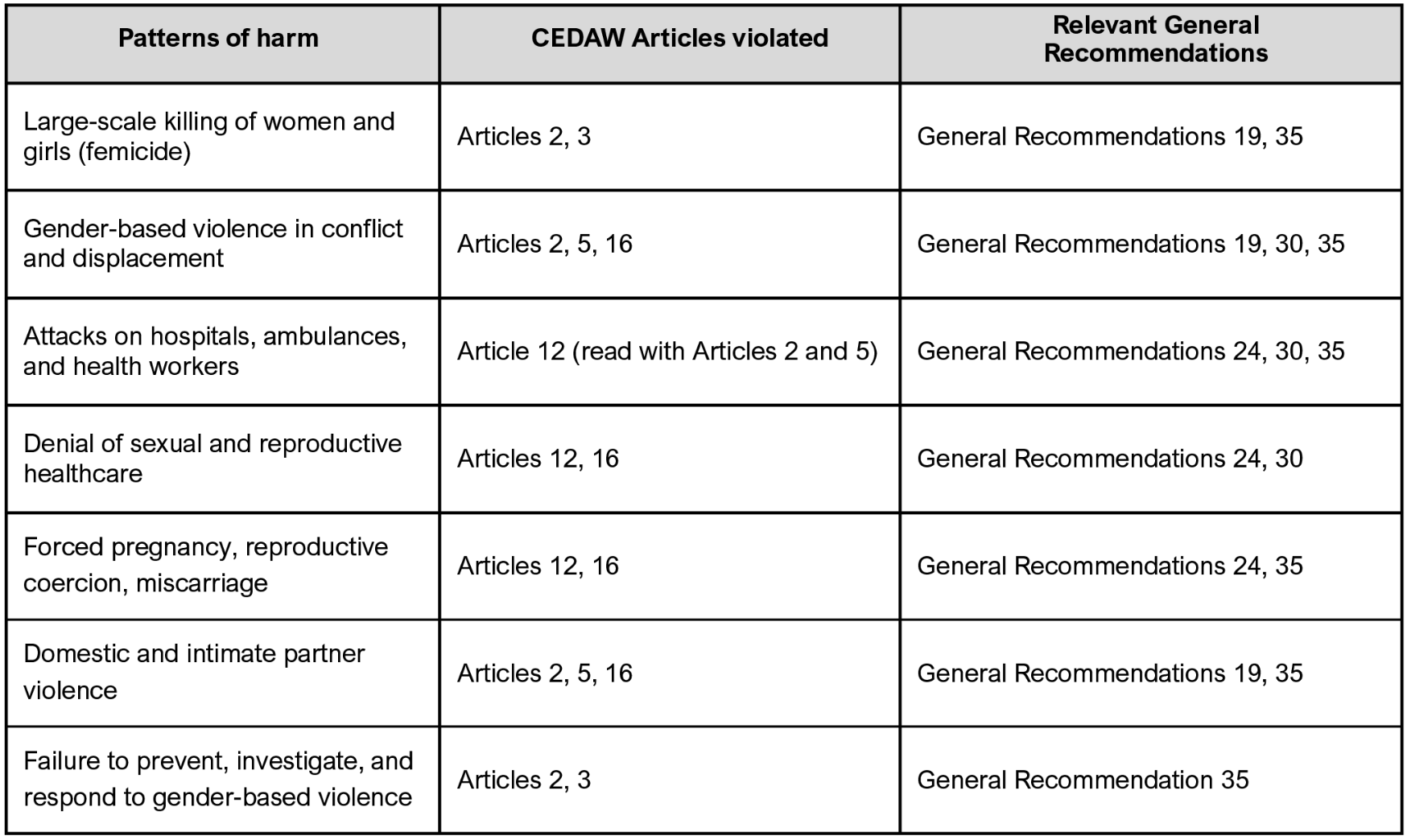
ANNEX I. Analytical Mapping of Documented Violations to CEDAW Obligations
This annex provides an analytical mapping of the patterns of harm documented in this emergency alert to relevant provisions of CEDAW and its General Recommendations. It is intended to support legal clarity and internal review by illustrating how large-scale violence against women and girls, attacks on healthcare, denial of SRHR services, and failures to prevent and respond to gender-based violence engage States’ obligations under international human rights law. The annex is complementary to the narrative section and does not constitute a comprehensive legal determination.
References
Insecurity Insights (2025) Attacks on Health Care in the Occupied Palestinian Territory: Late November–December 2025. Accessed 9 January 2026. https://insecurityinsight.org/wp-content/uploads/2025/12/70.-26-November-09-December-2025-Attacks-on-Health-Care-in-the-oPt.pdf.
Middle East Eye (2026) Israel is Waging a Reproductive Genocide against Palestinian Mothers in Gaza. 4 January 2026. Accessed 9 January 2026. https://www.middleeasteye.net/opinion/israel-waging-reproductive-genocide-against-palestinian-mothers-gaza.
MIFTAH (2025) Sexual and Gender-Based Violence, Reproductive Violence & Starvation: Mutually Reinforcing Crimes – Gaza. Accessed 7 January 2026. https://www.miftah.org/Display.cfm?DocId=29886&CategoryId=8.
Office of the United Nations High Commissioner for Human Rights (OHCHR) (2025) Amid Violence and Displacement: A Reproductive Health Crisis in Gaza – OHCHR. 11 December 2025. Accessed 28 December 2025. https://www.un.org/unispal/document/ohchr-press-release-11dec25/.
Office of the United Nations High Commissioner for Human Rights (OHCHR) Committee on the Elimination of Discrimination against Women. (1992–2017). CEDAW and General Recommendations Nos. 19, 24, 30, and 35. Accessed 28 December 2025. https://www.ohchr.org/en/treaty-bodies/cedaw
United Nations Office for the Coordination of Humanitarian Affairs (OCHA) (2025) Gaza Humanitarian Response Update | 2 – 15 March. 18 March 2025. Accessed 28 December 2025. https://www.ochaopt.org/content/gaza-humanitarian-response-update-2-15-march-2025.
United Nations Office for the Coordination of Humanitarian Affairs (OCHA) (2025) Humanitarian Situation Update #345: Gaza Strip. 4 December 2025. Accessed 28 December 2025. https://www.ochaopt.org/content/humanitarian-situation-update-345-gaza-strip.
United Nations Relief and Works Agency for Palestine Refugees in the Near East (UNRWA) (2025) Situation report #199: Situation in the Gaza Strip and the West Bank, including East Jerusalem. 2 December 2025. Accessed 28 December 2025. https://www.unrwa.org/resources/reports/unrwa-situation-report-199-situation-gaza-strip-and-west-bank-including-east-jerusalem.
Palestinian Central Bureau of Statistics (PCBS) (2025) The Status of the Palestinian People at the End of 2025: Statistical Evidence of Humanitarian and Demographic Catastrophe. Accessed 2 January 2026. https://www.pcbs.gov.ps/portals/_pcbs/PressRelease/Press_En_PalPeopleEnd2025E.pdf.
UN Women (2025) Over 28,000 women and girls killed in Gaza since October 2023. 19 May 2025. Accessed 28 December 2025. https://www.un.org/unispal/document/un-women-press-release-19may25/?utm_source=chatgpt.com.
United Nations Population Fund (UNFPA) (2025a) Gender-based Violence Trends Analysis: Gaza, April–May 2025. Accessed 28 December 2025. https://palestine.unfpa.org/sites/default/files/pub-pdf/2025-09/Gaza-GBV-Trends-April-May-2025-R.pdf.
United Nations Population Fund (UNFPA) (2025b) Gender-based Violence Trends Analysis: Gaza, June–August 2025. Accessed 28 December 2025. https://palestine.unfpa.org/en/publications/gbv-trends-analysis-gaza-june-august-2025.
United Nations Population Fund (UNFPA) (2025c) Situation Report on the Crisis in the Occupied Palestinian Territory – May/June 2025. Accessed 28 December 2025. https://www.unfpa.org/resources/situation-report-crisis-occupied-palestinian-territory-mayjune-2025.
Tasnim News Agency (2025) Storm Floods Gaza Shelters as Conditions Worsen Under Blockade. 26 November 2025. Accessed 28 December 2025. https://www.tasnimnews.com/en/news/2025/11/26/3457356/storm-floods-gaza-shelters-as-conditions-worsen-under-israeli-blockade.
Escalating Violence Against Women and Girls and Severe Sexual and Reproductive Health and Rights Violations in Gaza
EMERGENCY ALERT